The Life Timeline - My facts, your conclusion
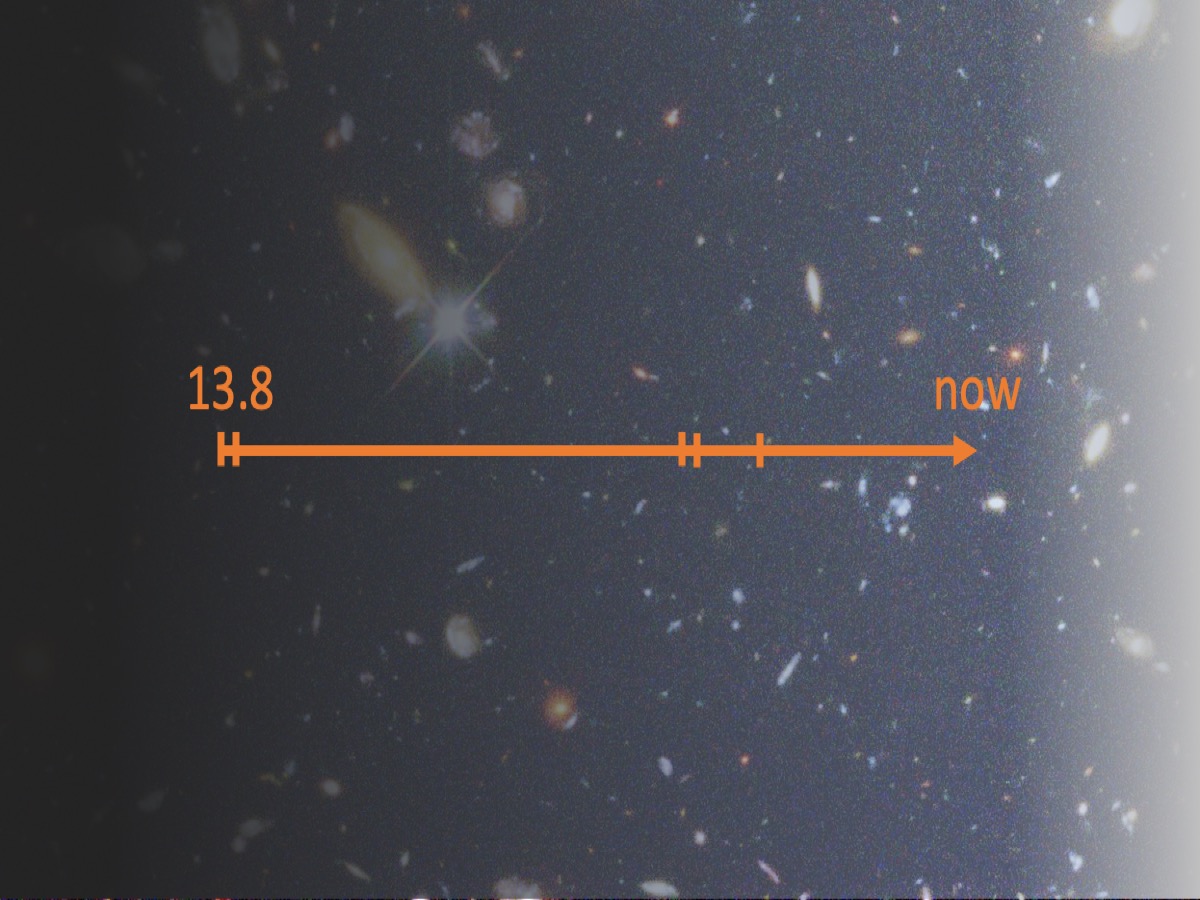
The facts
The events on a timeline are a great way to see relations and enable you to view the future with an improved lens. Let me tell you facts about the life and the universe. The facts are not new but I believe that you can draw many conclusions by putting them in a context.
The Universe is 13.8 billion years old
Through a range of measures and calculations, scientists can look back and narrow down the origin of the current universe to 13.8 billion years with an uncertainty down to only 20 million years. (1)
In other words, none of the celestial bodies we see in the night sky existed before 13.8 billion years ago.
Our Galaxy, the Milky Way is 13.6 billion years old
Most of the galaxies including our galaxy the Milky Way, were formed when the universe was very young, within the first 200 million years (2). And looking at the oldest stars in the galaxy, scientists have narrowed down the age of the Milky Way to be around 13.6 billion years.
In other words, our galaxy and many stars in our galaxy exist right from the big bang time.
The Sun is 4.6 billion years old
Our sun is relatively young in the solar system. After 9 billion years of Milky Way's existence, from a cloud of gas, our Sun was formed (3). By performing radioactive dating on meteorites shows that the Sun is 4.6 billion years old(4).
In other words, many stars in our galaxy had a head start of two to three times the age of our sun.
The planet Earth is 4.5 billion years old
The Sun's formation from the interstellar gas cloud created a spinning, swirling disk of material. The material in the disk clumped together in different sizes and they became planets (5). By measuring rocks using radiometric dating techniques, scientists can identify that the Earth formed around 4.54 billion years ago(6).
In other words, the planets and the Sun formed within the same celestial moment.
The first living organism appeared
The fossils tell a story of living beings in the past and the environment in which they used to thrive. Microscopic living things like bacteria can be found in mud and rocks have been adopted to the environment for millennia. The oldest cyanobacteria-like fossils known are nearly 3.5 billion years old (7).
In other words, the DNA based life as we know was present within the first billion year.
Biosphere is here to amaze you
For a fragile human who needs everything just right for a mere existence, extremophiles pose a mental challenge. The bacteria have been found to be living 6.7 kilometres inside of Earth's crust.(8) The life survived in harsh radiation condition outside the ISS.(9) 100 million years old dormant bacteria has sprung to life in a right environment condition(10). The life has shown resilience against extreme pressure, temperature and lack of nutrients. (8)
In other words, the DNA based life we know, can happily survive and thrive in the most unusual environments form human view point. The life has demonstrated - it is made for an existence in the Universe.
Now, take a moment and think - what happens when you connect the dots?
Let me summarise the facts for you...
When universe formed, the galaxies formed within no time.
When our sun formed, the planets formed within the same celestial moment.
Not long after the planet formed, DNA based life showed up.
Even the life as we know it, can adapt, survive and thrive in the 'universal' conditions.
What is your conclusion?
If its still not clear, please take a moment and read summary again. The idea of the article is not to force a viewpoint, rather get you thinking. If you stop on timeline after every fact, you may derive more than one conclusions.
Feedback
The above sequence may be extended through appearance of plants which are very new on the planet earth. And the Cambrian explosion is intentionally left out as it makes a part of other #deepthinking concept.
References:
(1) Age of the universe - https://wmap.gsfc.nasa.gov/universe/uni_age.html
(2) Age of the galaxy - https://spaceplace.nasa.gov/galaxies-age/en/
(3) Age of the sun - https://solarsystem.nasa.gov/solar-system/sun/in-depth/
(4) Age of the sun - https://www.nobelprize.org/prizes/uncategorized/the-age-of-the-sun-2/
(5) Solar system formation - https://solarsystem.nasa.gov/solar-system/our-solar-system/in-depth/
(6) Age of the earth - https://pubs.usgs.gov/gip/geotime/age.html
(7) Oldest life https://ucmp.berkeley.edu/bacteria/bacteriafr.html
(8) Extreme life -https://www.ncbi.nlm.nih.gov/pmc/articles/PMC4187170/
(9) Extreme life - https://blog.nationalgeographic.org/2013/08/02/5-extreme-life-forms-that-live-on-the-edge/
(10) Extreme life -https://www.abc.net.au/news/2020-07-29/scientists-revive-100-million-year-old-bacteria-under-seafloor/12501526